As we were traveling along, Csilla narrated some of the history of Hungarians, Romanians, Romany and Jews in Transylvania. Here, although Transylvania is historically Hungarian, the ethnic Transylvanian Hungarians are now the minority, and the Unitarians a double minority. But what sticks in my mind most strongly is the depth of emotion when Csilla spoke of her grandparents being Hungarian and Romanian and Hungarian and Romanian again, all without ever moving, of losing homeland and ethnic identity--and this time for good and all, now and forever second-class and somehow, through no fault of their own, second-rate.
Jere
This photo is of the building next to the Unitarian church in Brasov. We drove past before I could get my camera ready, though the church is a very similar building.
Sunday, April 14, 2013
Saturday, April 13, 2013
Hi Honey, We're Home!
All twelve of our travelers have now arrived in Transylvania!
Our first destination was a hotel on the side of a snow capped mountain, the second highest mountain in Romania. We were greeted by a green-grassy spring when we got off our plane, but by the time we made it up the mountain we had rolled back the calendar to winter.
We ate a traditional Romanian meal for dinner, involving pork, sausage (grilled veggies for the vegetarian), and salty polenta with a soft-cooked egg on top. After six plus hours in airports, ten plus hours in planes, and two plus hours on the road, everyone was exhausted but glad to have finally arrived.
This morning, Saturday morning, we are well-slept and well-fed and ready for a wonderful day. We're heading off for a visit at the Romanian royal family's summer residence, Peles Castle, as well as a stop at what is called here "The famous black church" before we go meet up with the Unitarian high school student we sponsor and her family.
Last night the Rev. Claudia reminded us we are visiting the homeland of our religious ancestors. We're invited to think about what it means to call this place our home, while also honoring that we are guests as well. We'll post more soon!
Our first destination was a hotel on the side of a snow capped mountain, the second highest mountain in Romania. We were greeted by a green-grassy spring when we got off our plane, but by the time we made it up the mountain we had rolled back the calendar to winter.
We ate a traditional Romanian meal for dinner, involving pork, sausage (grilled veggies for the vegetarian), and salty polenta with a soft-cooked egg on top. After six plus hours in airports, ten plus hours in planes, and two plus hours on the road, everyone was exhausted but glad to have finally arrived.
This morning, Saturday morning, we are well-slept and well-fed and ready for a wonderful day. We're heading off for a visit at the Romanian royal family's summer residence, Peles Castle, as well as a stop at what is called here "The famous black church" before we go meet up with the Unitarian high school student we sponsor and her family.
Last night the Rev. Claudia reminded us we are visiting the homeland of our religious ancestors. We're invited to think about what it means to call this place our home, while also honoring that we are guests as well. We'll post more soon!
Monday, April 8, 2013
Winding Up in Kolozsvar
Just Four Days Remaining in the Archives
I can't believe how quickly my time volunteering in the Archives has gone. With a big Easter break and some days in Budapest, I want to finish as much cataloguing as I can of the English and American correspondence with the Hungarian Unitarian Bishop from 1823-1921. I'll be lucky if I get it half done!Today I was reading American letters from first American Unitarian President Samuel Eliot and organizers of international conferences. As WWI loomed, the conferences stopped and Hungary suffered under battle with America's homeland untouched. In a letter soon after the war ended, Samuel Eliot told the Bishop of the American Unitarian's plan to match American congregations with Transylvanian churches decimated by war (now in Romania, not Hungary). This became the Partner Church program, then called sister churches.
In the earliest days, around 1870's, wealthy American Unitarians were sending money to the Unitarian Seminary via Bishop Ferencz Joseph in Kolozsvar to help support professors. They were well intended and often the money came erratically with the vagaries of international money exchange and political realities.
A Few Pictures....
Torda Gorge a treasured natural area.
Freedom Bridge in Budapest above.
Transylvanian valley below- haven't seen the sun in 10 days, light rain.
It reminds me of Ohio gray days in college.
Inside passenger car, above.
Train coming in to Kolozsvar Station, below.
Views from the Kolozsvar-Budapest train
Gypsy "houses" above.
Grazing sheep below- many lambs this time of year.
Trial run with Scott and Sierra-Marie for Skyping next Sunday with Boglarka went well.
It was fun to see Scott and Sierra-Marie in my office setting it up on my computer.
Hope to see you next Sunday! A nine of you I will see on Friday in Sinaia.
Welcome to Transylvania!
Wednesday, April 3, 2013
Easter, Easter, Easter
Eggs, Eggs Eggs
Traditional dyeing method taught by religon teacher/Minister along with
a time around a table with candles talking about the last supper.
Transylvanian Unitarians believe that Jesus died in the crucifixion-
no resurrection, no coming to life, no miracles
Easter is a celebration of Jesus' life and teachings.
The Bible is interpreted using reason, science, historical criticism.
Bibi, the English teacher, applying fine wax lines on egg with stylus- very labor intensive.
Finished products, dyed red with wax rubbed off and bacon fat applied for shine.
A sneak peek from Bibi's class, just before Easter break.
Off to Torocko for Easter
The bell tower of the Unitarian Church in Torocko from our guest house. And the amazing rock mountain.
This is old iron mining country.
Left, Levi, our host, Lehel who drove us up and my daughter Martha who joined me for a week.
The new healthy method....
Wrapping eggs with herb spring and old nylons.
Dyeing in onion skins and beets.
Unwrapping
Finished!
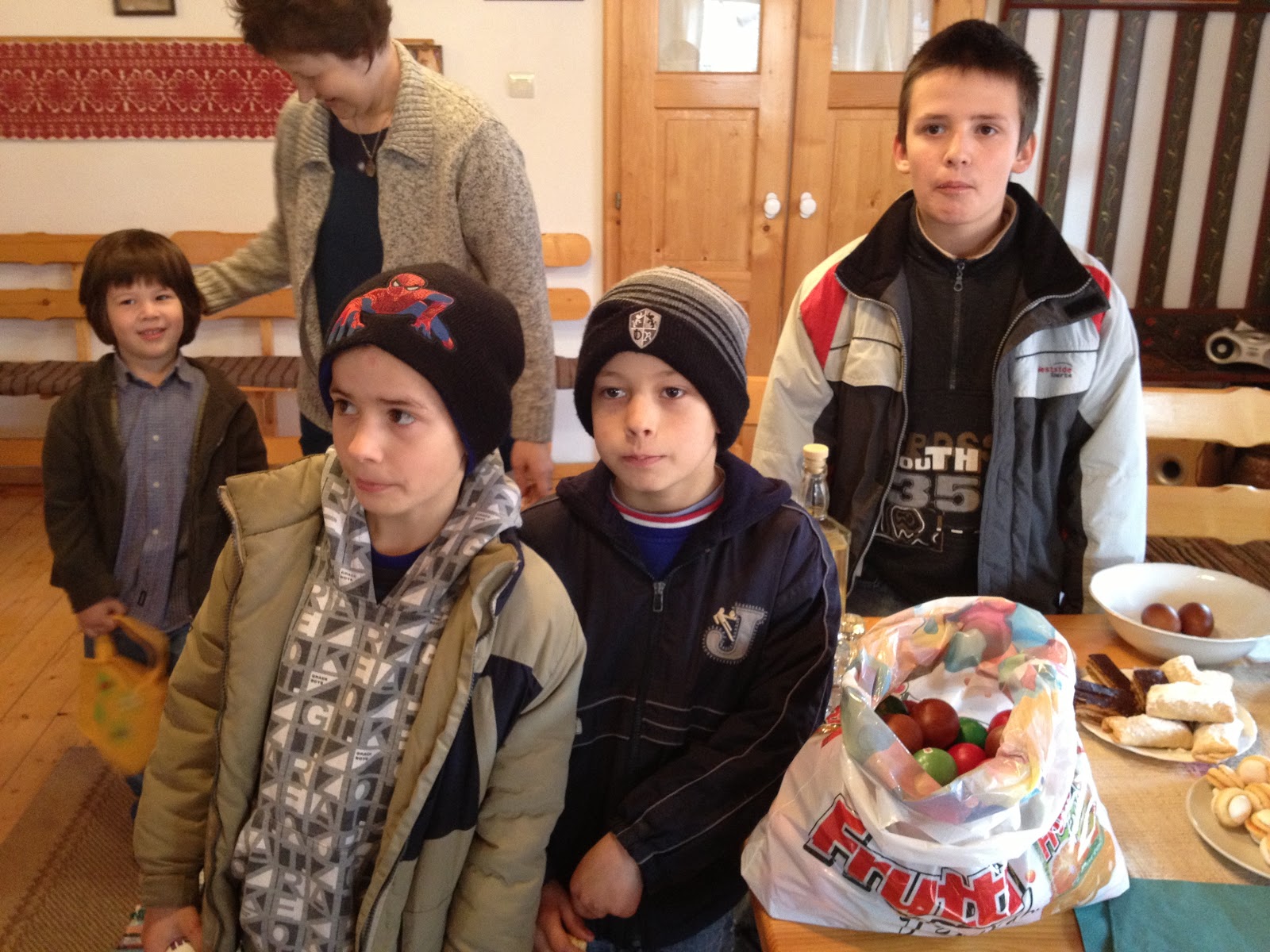
Little boys with egg stash, spray bottles in pockets,
ready to say sweet flower poems.
folks ignored time and came to church when bell rang an hour late!
The shy little sprayer, Mom helping him remember his poem!
John, Csilla and Easter
John and Csilla in Kolozsvar
We're in good hands and will miss John!
Giving and Abundance
A school celebration, speaker Kovacs Sandor, Church History Professor at the Unitarian Seminary
(This reminded me of our stewardship campaigns)
but with fun dancing!
More on Easter Next.....
Thursday, March 28, 2013
Deeper in the Unitarian Archives in Kolozsvar

The Unitarian Archives have been raided by the many invaders of the last centuries. Probably the most damaging were the Communists who simply claimed ownership of everything and removed
many ancient manuscripts to their state libraries. Currently Molnar Lehel, Archivist, is looking for a 1566
Cathechism where Fenencz David, George Biandrata and others recast the Heidleberg Cathecism
in an early Unitarian light. It was removed from the Unitarian Library in 1948 and was in the Romanian Library. It was not there several weeks ago when he looked. He has learned of fragments in a library in Hungary. The search goes on.
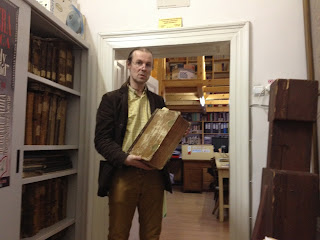
Meanwhile, Lehel is holding the 18th century Unitario-Ecclestiastica Historia Transylvania.
This religious history is in Latin
and is the life work of two men in succession, John Kenosi-Tozser and Steven Uzoni Foszto.
Remember this oddly-shaped wooden case? Lehel found it in a dusty storage room and inside was a cello,
badly damaged. It turned out it belonged to a Unitarian renaissance man- scholar, educator, musician for whom the high school is named- Brassai Samuel. The cello has been restored and a master cellist has been chosen to play it for three years, then it will go on to another with the provision that the cellist
play for special High School events.
Work table for a volunteer who is archiving local Unitarian church records.
Back to my work place- note front of cello case. Lately I have been intrigued by a letter by
James Martineau, preeminent British Unitarian minister, theologian,
author and principal of Manchester New College.
He wrote a stunningly beautiful letter to Bishop Ferencz Joseph in Kolozsvar in 1879 on the 300th anniversary of the death of Ferencz David,
"We do not address you as strangers. More than half a century ago, when our (British Unitarian) Association was formed, one of its first duties was to open communication with your churches..."
Here is a close up of the big Transylvanian church history.
Parts of it have been edited and published recently.
1587-1606
Partiale Generalae Consistorium
The earliest recorded of the governing body of the church- a representative
group of clergy, lay people and staff.
The modern-day Consistorium met here last week.
Pakei Lajos was a preeminent Unitarian architect from Kolozsvar
who designed many major buildings here around 1900. He designed the headquarters/high school/seminary/ Bishop's office where I am staying in the attic!
This poster announces a special exhibition of his work and a scholarly
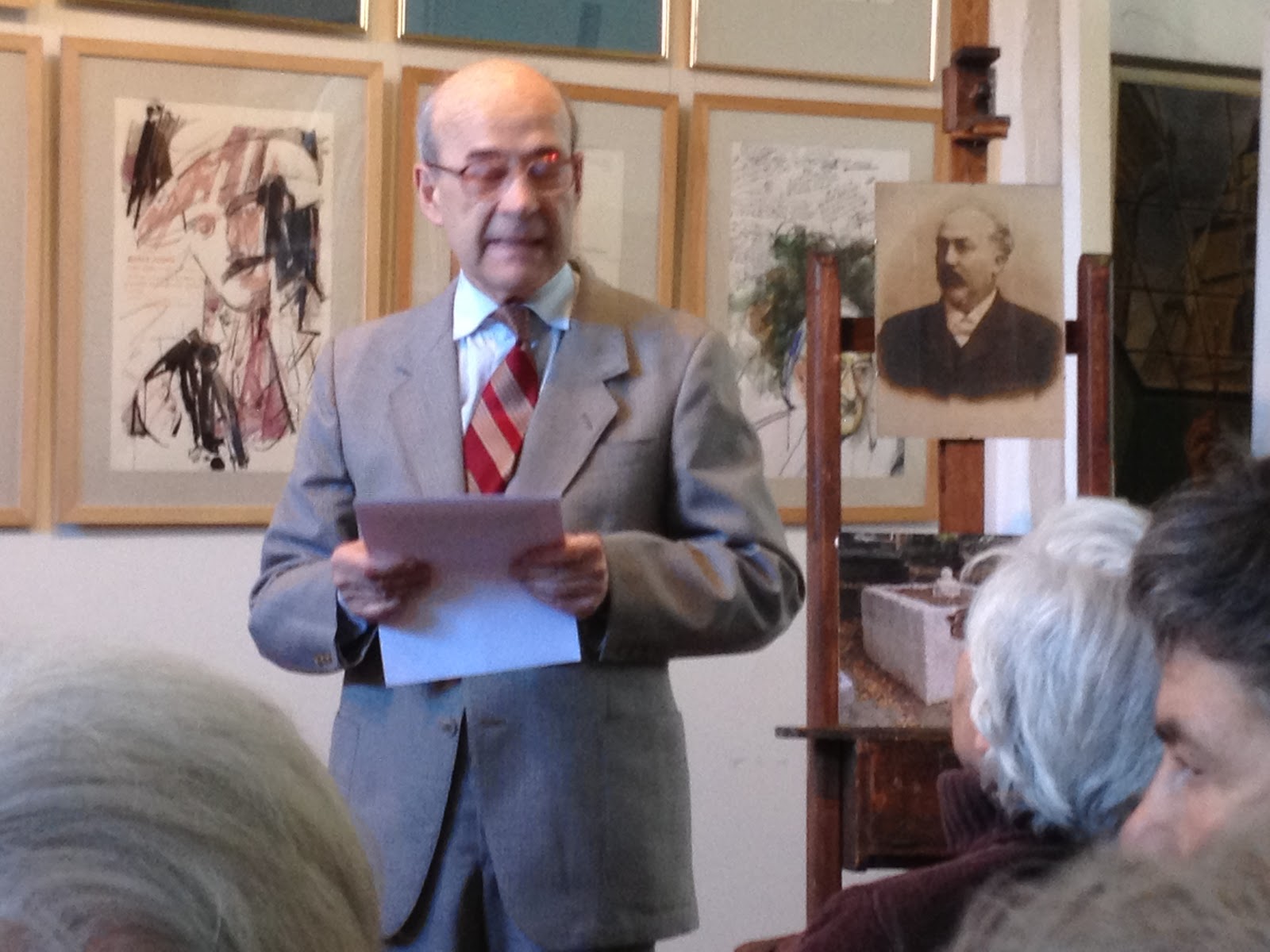
presentation based on a newly-published book of his work, author below (note Pakei photo to right)
Students studying Pakei's architectural drawing loaned from among 600 drawings in Unitarian Archives.
They were finding their rooms and the many stairways they travel.
Lehel as expert archivist at reception.
A nice entertainment at the Pakei reception and presentation.
Pakei's work- the Headquarter's building. He also designed the Unitarian High school in Szekelyudvarhely
where our Shoreline UU Pilgrimage is taking English books in mid April 2013. The drawing look very similar to the Kolozsvar school, but smaller. Lehel is from the town with the smaller school and attended it. His father and grandfather ran the local museum in town.
Au revoir! I'm taking off for the Easter Break and will share
how Transylvania Unitarians celebrate Easter
in about ten days.
We may have more in common than you might imagine!
Rev. Claudia
Monday, March 25, 2013
Flower Sunday
Still Sunday, March 24
Young men who helped up front with flowers brought the vases to the exits and
passed flower to everyone in the service.
Recognize the large stone on the right?
The Minister of the Kolozsvar Unitarian Church in his clerical robe/cape. Just before taking this picture
I asked him about the flower ceremony English is excellent. He said this is the third year they have done it-
it is new to them!
I told him we did it in June. He said they don't call it flower communion,
like Norbert Capek did in Prague, because
when they have communion
about six times a year they eat bread, and they don't want to eat flowers!
This is the stone on which Ferencz David stoodin 1568 when he preached to the town and in the process everyone became a Unitarian, or so the story goes.
Can anyone read Hungarian?
Coffee hour on the street- note Minister's long black cape.
More coffee hour....lingering.
Time for lunch.
Subscribe to:
Posts (Atom)